Riley Albrecht · 30 September 2026
Italy's Cultural Heritage Initiatives Drive Nordic Tech Advancements and Alter Mediterranean Commerce Patterns
Italy maintains numerous UNESCO-designated sites including the Colosseum adn historic districts in Florence, and authorities allocate substantial resources each year toward restoration projects that incorporate advanced digital mapping and structural monitoring systems. These preservation activities have created demand for specialized software tools developed by companies based in Sweden and Finland, where startups focus on 3D scanning applications and predictive analytics for aging stone and marble structures.
Heritage Projects Generate Demand for Nordic Innovations
Restoration teams working on Pompeii and the canals of Venice began integrating sensor networks and AI-driven decay models in 2024, and procurement records show that several contracts went to Nordic firms offering cloud-based simulation platforms. Data compiled by the European Commission indicates that Italian cultural authorities spent over 120 million euros on technology procurement between 2023 and 2025, with Nordic suppliers capturing roughly 18 percent of those contracts. Researchers at Lund University documented how one Stockholm-based startup scaled its team from 12 to 47 employees after securing a multi-year agreement to monitor humidity levels across 14 Italian archaeological parks.
September 2026 Conference Highlights Cross-Regional Collaborations
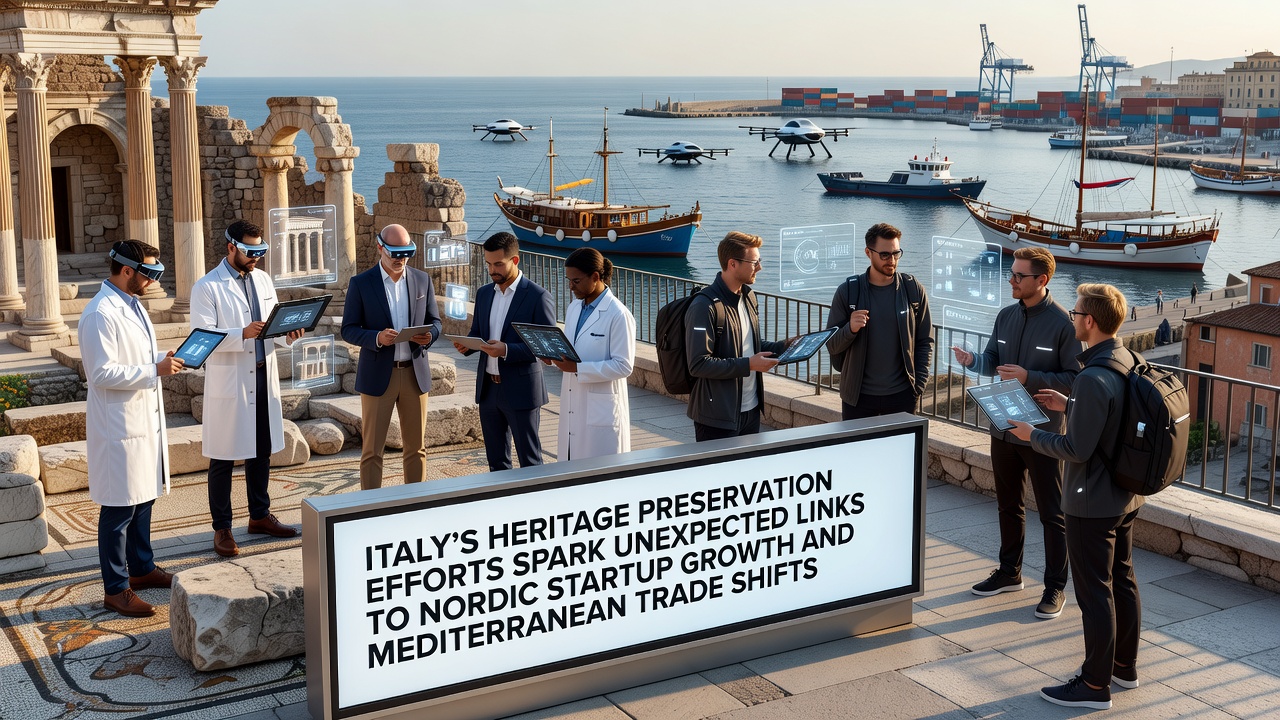
Officials have scheduled a joint workshop in Rome for September 2026 that will bring together heritage managers from Italy, trade analysts from Greece, and venture capital representatives from Oslo and Copenhagen. The event will feature live demonstrations of drone-based photogrammetry systems and blockchain-ledger prototypes used to track restoration material provenance. Organizers expect participation from 35 companies and 12 government agencies, building on preliminary agreements signed earlier in 2025 that established data-sharing protocols between Mediterranean ministries and Nordic research clusters.

Trade Route Adjustments Follow Technology Transfers
While heritage contracts expanded, shipping patterns across the Mediterranean shifted as new suppliers of specialized equipment entered the market. Ports in Genoa and Marseille recorded a 14 percent increase in container volume carrying precision sensors and laboratory-grade stone consolidants during the first half of 2025, according to statistics released by the Italian Ministry of Infrastructure. Trade analysts note that smaller vessels now make more frequent stops at secondary harbors in Croatia and Tunisia to deliver components directly to regional restoration sites, reducing reliance on larger transshipment hubs in Rotterdam. These adjustments have prompted shipping companies to revise routing algorithms, and several carriers have added seasonal services that align with the construction calendars of major Italian restoration campaigns.
Startup Ecosystems in Nordic Cities Record Measurable Growth
Employment figures released by Statistics Sweden show that firms specializing in cultural heritage technology added 620 positions in the Stockholm and Gothenburg regions during 2025. Similar patterns appear in Helsinki, where the Finnish Business and Policy Forum reported that heritage-related startups raised 47 million euros in seed and Series A funding over the same period. Observers attribute part of this expansion to repeated procurement opportunities originating from Italian public tenders, which require compliance documentation and performance guarantees that favor companies with established European Union certification. One case study compiled by the OECD describes a Trondheim-based firm that adapted its maritime sensor technology for underwater surveys of submerged Roman ruins near Naples, resulting in a licensing deal that contributed 9 percent of the company's annual revenue.
Conclusion
Italy's ongoing commitment to site preservation continues to intersect with Nordic technological capabilities and Mediterranean logistics networks. Official records and procurement data confirm that these intersections have produced measurable increases in startup employment and adjustments in regional shipping volumes. The September 2026 workshop is expected to formalize additional data-exchange frameworks, and further contract announcements will likely follow as additional Italian regions update their heritage management plans.